
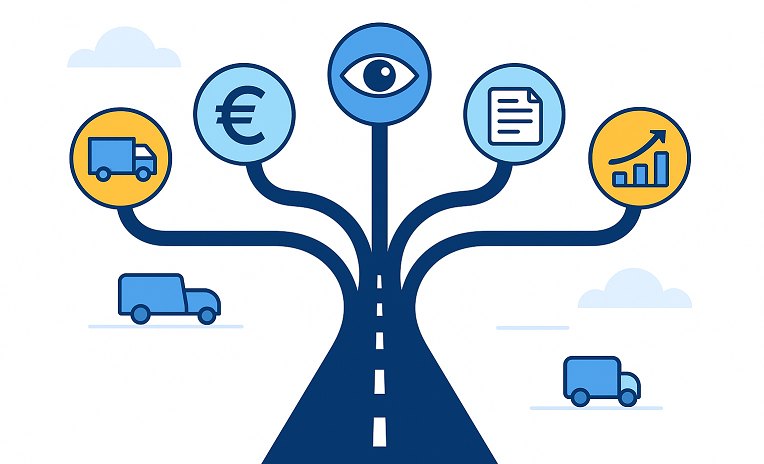
Transportation management is one of the most critical pillars of logistics today. Whether we’re talking about a large operator or a mid-sized company with its own fleet, moving goods efficiently, on time, and profitably is becoming increasingly complex.
Many companies still rely on spreadsheets, phone calls, and emails to organize routes, coordinate drivers, and manage documents. While these methods may work in the early stages, as the company grows or operations become more demanding, bottlenecks emerge that directly impact profitability and customer satisfaction.
This raises a key question: how can you know if your company needs to professionalize its transportation management with a TMS (Transportation Management System)?
In this article, we’ll explore the 5 most important signs that indicate the need for a TMS, the benefits it brings, and a practical example to understand how it can transform a transportation business.
What is a TMS and how does it improve transportation management?
A Transportation Management System (TMS) is specialized software that centralizes the planning, execution, and control of all activities related to the movement of goods.
Its role goes beyond route creation:
- It allows detailed analysis of transportation costs.
- It facilitates communication with customers and drivers.
- It digitizes documents and administrative processes.
- It provides real-time visibility of each shipment.
In short, a TMS acts as the “control center” of transportation management, helping companies work with data rather than guesswork and respond quickly to unexpected events.
5 signs your company needs to optimize its transportation management
1. Route planning is getting out of control
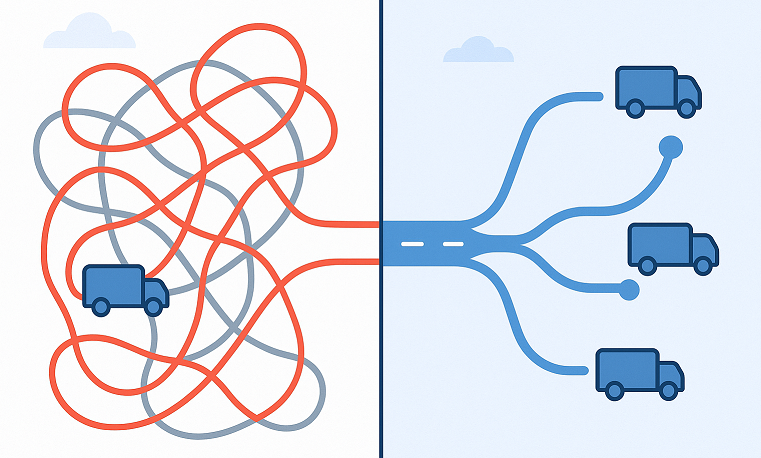
As order volumes increase, planning with spreadsheets can take hours and still result in inefficient routes. Factors such as time windows, restricted urban zones, or vehicle capacity add to the complexity.
A TMS generates optimized routes in minutes, considering all these variables and reducing unnecessary miles.
2. Transportation costs are difficult to control
Fuel, tolls, maintenance, subcontracting fees, or penalties for delays—all these factors affect profitability. But without a centralized system, it’s difficult to analyze them in real time.
Digitalized transportation management with a TMS makes it easier to identify cost leaks and propose corrective measures.
3. Your customers are demanding more visibility
Shipment traceability has become an expectation. Increasingly, shippers and end customers want to know where their order is and when it will arrive.
If your company cannot provide that visibility, competitiveness is lost. A TMS enables real-time tracking and reduces the number of calls to the dispatch office for updates.
4. Administrative processes are slow and error-prone
Invoices, bills of lading, pre-invoicing, contracts with subcontractors, regulatory documentation… When paperwork consumes too much time and errors are frequent, productivity suffers.
A TMS automates many of these processes, reducing errors and freeing resources for higher-value tasks.
5. Difficulty growing or adapting to seasonality
Many companies manage with manual processes until a seasonal peak or customer expansion arrives. At that point, improvised systems cannot handle the volume, and service quality drops.
Managing transportation through a TMS provides the flexibility to scale operations without disproportionately increasing costs.
Practical example: from spreadsheets to digital transportation management
Imagine a regional transportation company with 25 vehicles in its fleet. For years, it organized routes using Excel spreadsheets and phone calls to drivers. While the system seemed to work, problems soon appeared:
- Constant delays due to poorly optimized routes and lack of traffic information.
- Rising fuel and maintenance costs from unnecessary detours.
- Customer complaintsfrom not receiving accurate delivery updates.
- Administrative overloadwith hours spent reconciling invoices and checking documents.
These problems are not isolated. Several studies confirm the benefits of digitizing transportation management:
- According to McKinsey, between 13% and 19% of logistics costs come from inefficiencies at interaction points (such as deliveries without visibility). Better digital management can reduce this waste by up to 40%.Fuente).
- The Centro Español de Logística (CEL) highlights in several publications that digitalization significantly reduces the time spent on administrative tasks.Fuente).
- A report from PwC notes that providing real-time traceability to customers reduces up to 30% of follow-up calls to the dispatch office.Fuente).

If we apply these figures to our example, the company could achieve within just a few months:
- Cut route planning time from 3 hours a day to less than 30 minutes.
- Save between 10% and 15% on transportation costs.
- Improve customer satisfaction thanks to real-time visibility.
- Free up administrative resources and reduce billing errors.
This example shows how transportation management can shift from being an obstacle to becoming a driver of competitiveness.
Benefits of a transportation management system
A TMS delivers advantages across different levels of operations:
- Reduced operating costs through optimized routes and efficient resource use.
- Increased customer satisfaction, thanks to improved punctuality and real-time information.
- Administrative automation, reducing human error and freeing internal resources.
- Complete operational visibility, key to making agile and informed decisions.
- Scalability, easily adapting to demand peaks or growth plans.
Conclusion: professionalizing transportation management is a necessity
If your transportation company faces challenges with planning, lack of visibility, uncontrolled costs, or slow administrative processes, it may be time to rethink how you manage transport.
A TMS is no longer a tool reserved only for large corporations: more and more small and mid-sized logistics companies are adopting this technology to take a qualitative leap in competitiveness.

Communications & Marketing Responsible at Hedyla
Multimedia Technical Engineer. Working 11 years in the Audiovisual and Communication Department of a multinational company. Responsible for the Marketing and Communication Department in several companies in the technology sector.
Designing digital strategies. Innovating and adding value to communication.