
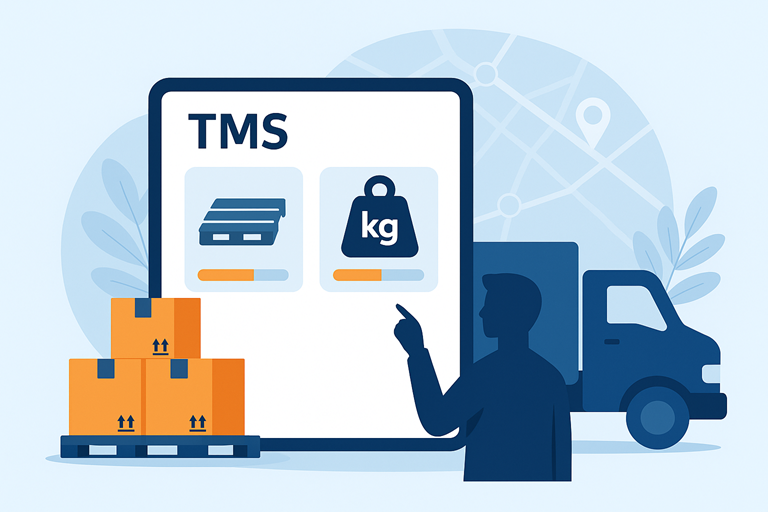
Tracking weight capacity in a TMS has become an essential indicator for transportation and distribution companies. Planners increasingly need to understand not only how much space each shipment occupies, but also how many kilograms each vehicle is accumulating before starting its route. And this is where weight control stops being just a technical data point and becomes a practical tool that helps avoid errors, improves efficiency, and enables safer, more informed decision-making.
In addition, many operations require managing multiple simultaneous capacities, such as volume (m³), pallet type, liters, or linear meters, because not all loads are defined only by weight or pallet space. For this reason, incorporating weight capacity into a TMS is a key first step toward achieving a more complete and accurate planning process.
Below are five reasons why this functionality brings real value to transportation management.
1. Greater accuracy in load planning
One of the main advantages of adding weight capacity in a TMS is the ability to understand the actual load each vehicle is carrying.
In many operations, two orders may take up the same number of pallets but have drastically different total weights. If planning is based solely on pallet count, it can be incomplete or even lead to errors.
By visualizing the percentage of pallets and kilograms used, planners gain a complete picture and avoid exceeding legal weight limits, improving both route safety and reliability.
This same logic expands when the TMS can manage multiple simultaneous capacities, integrating volume, linear meters, or liters for operations where weight is not the only critical factor.
2. Reduced operating costs and better fleet utilization
A TMS software that considers both volume capacity and weight capacity allows each trip to be optimized.
When the system detects that a vehicle is approaching its weight limit, it prevents additional freight from being assigned to that route and suggests more efficient alternatives.
This directly results in:
- Fewer extra trips
- Lower fuel consumption
- Fewer empty or underutilized kilometers
- A much more balanced use of the fleet
Weight capacity in a TMS—combined with simultaneous capacities such as m³ or linear meters—provides a more accurate view of actual vehicle utilization, reducing inefficiencies that can become significant cost drivers at a weekly or monthly scale.
3. Regulatory compliance and risk reduction
Exceeding the legal weight limit of a vehicle can lead to fines, inspections, delays at checkpoints, and even safety risks for the driver and the cargo.
By incorporating weight capacity in a TMS, planners have a clear visual reference of accumulated weight per route, allowing them to detect critical situations before the vehicle hits the road.
When the system also supports multiple simultaneous capacities, loads become balanced not only by weight, but also by volume or length, increasing stability and reducing additional risks.
This functionality also helps ensure compliance with national and European regulations, reducing incidents and improving traceability.
4. Smarter planning in last-mile and urban distribution
In last-mile operations, shipment volume may be small but densit, and therefore weigh, can be very high.
By integrating weight capacity into the planning panel and KPI dashboards, planners can better balance loads across vans, light vehicles, and trucks.
This makes it possible to:
- Prevent small vehicles from receiving more weight than allowed
- Distribute freight according to vehicle type and usable capacity
- Reduce operational issues in urban areas with additional restrictions
When the TMS manages multiple simultaneous capacities, these decisions become even more precise, as it verifies not only weight but also volume or linear occupancy. This turns planning into a much more accurate logistical process rather than a simple volume-based exercise.

5. Data-driven decisions and clearer visual planning
The new visualization of weight capacity in a TMS makes daily planning far easier.
At a glance, planners can see:
- % pallet occupancy
- % weight occupancy
- Remaining vehicle capacity
- Alerts when maximum load is exceeded
In more advanced TMS solutions, this view is complemented by additional capacities such as volume, liters, or linear meters, allowing for an even more accurate understanding of the vehicle’s state.
In practice, this translates into faster decisions, fewer errors, and a more balanced assignment of orders.
Especially when planning from the map, discarding certain areas or orders that don't fit the route, having these parameters is essential to build coherent and efficient routes.
Practical example: how weight capacity in a TMS prevents planning errors
Imagine a food distribution company that must plan 18 orders for a local route. Each order occupies one pallet, so at first glance they would fit perfectly in a truck with a 20-pallet capacity.
If planning were based solely on volume, the assignment might seem correct.
However, when activating weight capacity in the TMS, the system detects:
- The total weight of the 18 orders reaches 12,800 kg
- The vehicle’s maximum capacity is 12,000 kg
Even though 2 pallets are still available, the truck is 800 kg overweight.
The TMS displays a visual warning and blocks the planning to prevent assigning the excess load.
In more advanced operations, if the TMS also manages multiple simultaneous capacities, it could detect additional issues such as:
- Excess volume
- Insufficient linear space
- Incompatible pallet types
This provides an additional layer of protection against errors that, in real operations, generate costs, risks, and delays.
Conclusion: a key step toward more efficient logistics
Incorporating weight capacity in a TMS is not just a visual enhancement; it represents a substantial leap in planning quality, fleet safety, and transportation optimization.
Companies that adopt this functionality achieve more balanced routes, reduced operating costs, and fewer loading errors.
And when the system also supports multiple simultaneous capacities, planning becomes far more precise, realistic, and aligned with the complexity of modern logistics.
A TMS with this level of capability becomes a strategic tool for any company seeking improved precision, competitiveness, and operational control.

Communications & Marketing Responsible at Hedyla
Multimedia Technical Engineer. Working 11 years in the Audiovisual and Communication Department of a multinational company. Responsible for the Marketing and Communication Department in several companies in the technology sector.
Designing digital strategies. Innovating and adding value to communication.
A very informative read. Tracking weight capacity in a TMS is clearly essential for improving load optimization, reducing compliance risks, and controlling transportation costs. This article explains its impact in a practical and easy-to-understand way.
Thank you very much for your comment!
We’re glad to hear that you found the article clear and useful. Managing weight capacity in a TMS is key to optimizing loads, reducing risks, and controlling transportation costs. Thanks for reading us!