
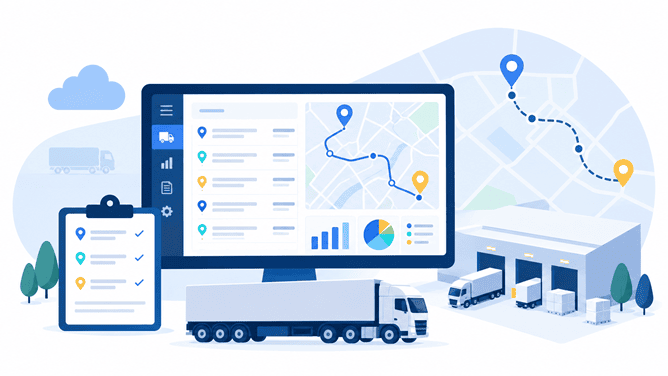
Reducing empty miles with a TMS is one of the most direct ways to improve transport efficiency. Every mile travelled without a load consumes fuel, takes up driver and vehicle time, and generates a cost that is difficult to pass on to the customer.
However, empty miles are not always easy to avoid. A delivery may end far from the next pickup point, there may be no compatible loads available for the return journey, or time windows, capacity or availability constraints may prevent combining trips that initially seemed easy to coordinate.
This is where a TMS (Transportation Management System) can help. By working with information on orders, vehicles, capacities, locations, schedules and carriers, it can analyse more planning alternatives and find more efficient combinations of loads and routes.
Why do empty miles occur?
A vehicle can travel empty for many reasons. The most obvious example is the return journey to base after completing a delivery, but it is not the only one.
Empty miles can also occur when a vehicle has to travel to its next pickup point, when loads are assigned independently without considering the rest of the transport plan, or when there is insufficient visibility of available orders.
Operational constraints also play a role: customer time windows, vehicle capacities, delivery priorities, driver availability or specific requirements associated with certain orders.
Reducing empty miles therefore requires looking at transport planning as a whole. A TMS can generate a plan based on the orders to be completed, seeking to minimise distance travelled, the number of routes and the resources required.
1. Combine loads, deliveries and pickups more effectively
One of the first opportunities is to avoid planning each service as an isolated operation.
If upcoming deliveries and pickups are known in advance, the TMS can look for compatible combinations. A vehicle completing a delivery may be able to continue to a nearby pickup instead of returning directly to its point of origin.
To do this effectively, schedules, capacities, driving times and other operational constraints also need to be considered.
The more information that can be analysed together, the greater the chances of finding alternatives that reduce unnecessary journeys.
2. Improve vehicle utilisation
Not every inefficient mile is travelled with a completely empty vehicle. Low vehicle utilisation can also indicate room for improvement.
Load management makes it possible to analyse available fleet capacity and find a better distribution of orders. The aim is to improve load factors and avoid using more vehicles or routes than necessary.
This is particularly relevant when managing multiple orders, partial loads or vehicles with different capacities.
Planning that takes weight, capacity and load characteristics into account can identify combinations that would be much more difficult to detect manually.
3. Plan return journeys from the outset
The return journey should be considered during planning rather than once the delivery has already been completed.
It is useful to assess what the vehicle can do after reaching its destination: whether there are nearby pickups, other available loads or opportunities to connect that service with another operation.
A TMS can work with multiple load and pickup orders within the same plan and analyse whether they can be combined while respecting the defined constraints.
This makes it possible to consider the complete journey rather than focusing solely on the outbound leg.
4. Assign loads more effectively to each carrier
When part of the transport operation is outsourced, carrier assignment can also influence the number of miles travelled.
Having information about loads, carriers, availability and rates within the same system makes it easier to find an appropriate assignment for each operation.
A TMS can manage both internal and supplier rates according to parameters such as load type, distance, full truckload or groupage. This information can then be used for automatic load assignment to carriers.
Integration with external platforms and freight exchanges can also broaden the available options when the existing transport plan does not provide a suitable alternative.
5. Include real operational constraints in planning
The shortest route is not always a feasible route.
A proposal may look efficient in terms of mileage until customer time windows, shifts, carrier breaks or vehicle capacities are taken into account.
It is therefore important for the TMS to incorporate real business constraints during the planning process.
This helps create routes that can actually be executed and reduces the need for subsequent adjustments, additional journeys or load reassignments.
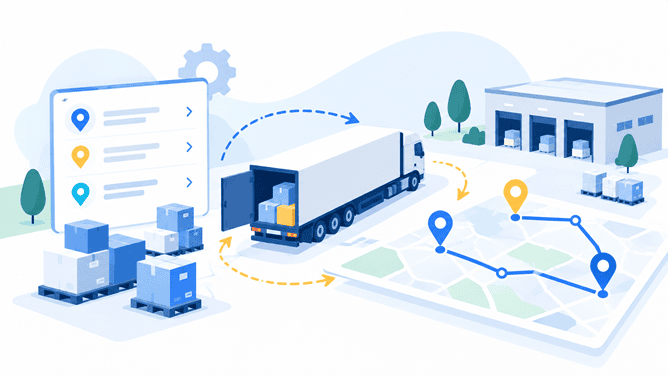
6. Replan when operations change
The initial transport plan rarely remains unchanged throughout the entire day.
Urgent requests, new orders, delays or incidents may require a route to be modified. When these changes are handled in isolation, additional unplanned mileage can easily be introduced.
Having up-to-date information on routes in progress and vehicle locations provides more context when making these decisions.
A route editing assistant can also help incorporate last-minute changes while keeping the overall transport plan in view.
7. Measure where empty miles are being generated
To improve an indicator, you first need to be able to see it.
Historical data can reveal which routes, customers, areas or types of service generate the most empty mileage. It can also help identify patterns that may go unnoticed during day-to-day transport management.
When this analysis relies on spreadsheets and manual data consolidation, obtaining a reliable overview of the operation becomes much more difficult. In this article, we explain when Excel is no longer enough to manage transport operations.
A TMS centralises operational information and provides KPIs that can be used to analyse performance.
Some useful indicators include:
- total miles travelled;
- empty miles;
- percentage of empty miles over total mileage;
- number of routes completed;
- number of routes completed;
- average distance per route;
- cost per mile or service.
Monitoring these indicators regularly helps determine whether the measures introduced are working and identify further opportunities for optimisation.
Strategies to reduce empty miles with a TMS
Situation | How a TMS can help | Intended impact |
Empty return journeys | Combine deliveries with new pickups | Reduce empty return mileage |
Low vehicle utilisation | Optimise order assignment according to capacity | Improve load factors |
Orders planned separately | Analyse loads and pickups together | Create more efficient routes |
Inefficient assignments | Consider availability, rates and transport requirements | Improve load assignment |
Multiple operational constraints | Include them directly in the planning algorithm | Avoid unfeasible routes and adjustments |
Changes during the day | Edit and adjust routes using up-to-date information | Limit additional mileage |
Limited performance visibility | Analyse KPIs and historical data | Identify patterns and opportunities for improvement |
Data quality also matters
A TMS can analyse many different alternatives, but it needs reliable information to do so.
Incorrect addresses, outdated vehicle capacities, incomplete schedules or orders with missing information will affect any automated planning process.
Before setting ambitious targets to reduce empty miles, it is worth reviewing master data quality and ensuring that the information required for planning reaches the system in a structured format.
Integration with other systems, such as an ERP, can also help avoid duplicate data entry and automatically incorporate orders and load orders into the planning process.
Fewer empty miles, better use of resources
Reducing empty miles has a direct impact on vehicle utilisation, fuel consumption, driver time and transport costs. It also helps make better use of available capacity without increasing fleet size.
A TMS can address this from several angles: load optimisation, automated planning, constraint management, carrier assignment, route tracking and KPI analysis.
Having reliable information across the operation makes it easier to assess each journey as part of the overall transport plan, including the options available to a vehicle once a delivery has been completed.

Communications & Marketing Responsible at Hedyla
Multimedia Technical Engineer. Working 11 years in the Audiovisual and Communication Department of a multinational company. Responsible for the Marketing and Communication Department in several companies in the technology sector.
Designing digital strategies. Innovating and adding value to communication.