
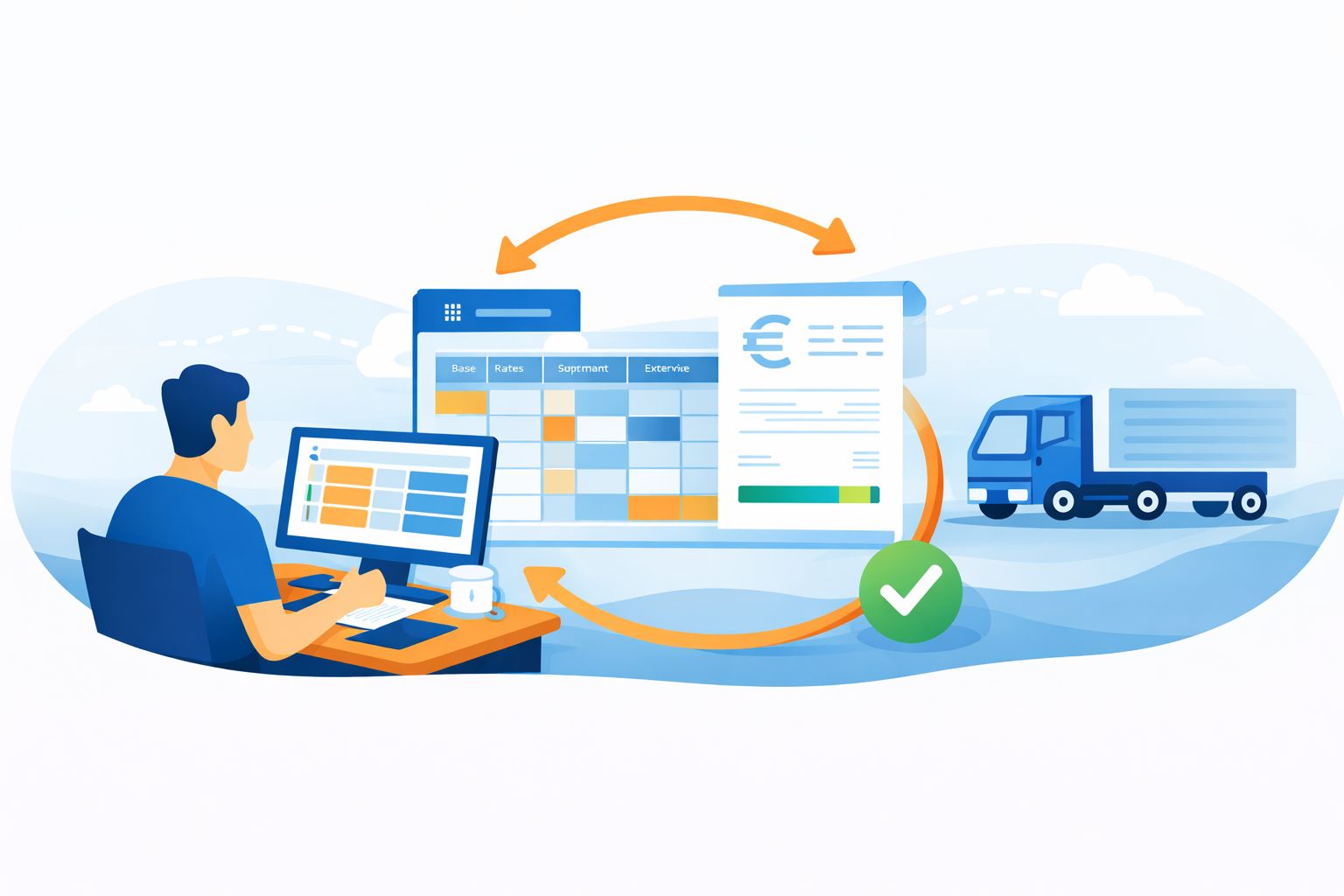
In 2026, the profitability of a transport company will no longer depend solely on optimizing routes or reducing empty miles.
More and more companies are discovering that part of their margin is not lost on the road, but in how their transport tariffs are defined and how pre-invoicing in transport is managed.
Surcharges that are not applied consistently. Fuel adjustments updated too late. Waiting times that are never billed. Small deviations that, when accumulated over months, can have a significant impact.
This is rarely the result of poor management. More often, it comes from tariff structures that are not properly integrated into daily operation
This guide is designed to help you review how your transport tariffs are defined, how they are applied to each service, and how to structure pre-invoicing to protect your real margins in 2026.
1. Understanding the starting point: what a professional tariff is and what it isn’t
Before reviewing numbers, it’s worth clarifying a key point.
A professional transport tariff is not simply a price per mile.
💡 What it is NOT
- A price agreed verbally
- An Excel file only reviewed by the finance department
- A contract that never reaches daily operations
💡 Cosa È
A clear structure that defines:
- Base price per service, zone, or route segment
- Automatic surcharges (waiting time, second delivery, ADR, temperature-controlled transport)
- Variable adjustments such as fuel surcharges
- Minimum billable amounts
- Objective conditions for applying each rule
If these rules are not integrated into operational workflows, their application will always depend on manual intervention.
2. Putting it into context: where margin losses really occur
Profitability losses rarely come from major mistakes. They usually come from small, repeated mismatches.
Imagine a typical scenario in a medium- or high-volume transport company:
- Some surcharges are not applied systematically
- Part of the waiting time never reaches pre-invoicing
- Fuel surcharges are updated with delays
This is not about losing control. It’s about small recurring deviations often linked to structural issues in economic calculations, similar to those found when reviewing common mistakes in calculating transport costs.
When these deviations occur across hundreds or thousands of shipments, the cumulative effect can become significant.
Most importantly, it often remains invisible until the annual results are analyzed.
3. Choosing a tariff model adapted to your operations
Not all companies need the same structure.
In practice, we usually find three common models.
Basic per-mile model
- Simple to apply
- Limited ability to capture complex scenarios
Structured model with defined surcharges
- Allows differentiation by service and conditions
- Requires clear and consistent rules
Model integrated into a management system
- Automated rules
- Direct application when creating the shipment
- Deviations are detected before the invoice is issued
The key is not only which tariff you use, but how it is applied to each real service.
4. Initial diagnosis: five key questions about your transport tariffs
Before introducing changes, it’s useful to analyze the current situation.
Are tariffs digitally structured?
Are surcharges applied automatically?
Is the fuel surcharge updated using a defined rule?
Is there consistency between what is planned and what is billed?
Can you estimate the margin per shipment before execution?
If several answers raise doubts, the problem is not workload. It is the tariff structure.

5. Transport pre-invoicing: the moment when margins are decided
Pre-invoicing in transport is not simply a step before issuing the invoice. It is the moment when the executed service becomes or fails to become real revenue.
When it depends on manual reviews:
- Billing is delayed
- Concepts are forgotten
- Later adjustments are required
- Cash flow becomes strained
When tariffs are integrated into operations:
- Rules are applied automatically
- Surcharges are calculated based on predefined conditions
- Deviations are detected before the invoice is issued
The difference is not only administrative. It is financial.
6. Integrating planning and financial control: the new standard in 2026
More and more companies are adopting a different perspective: Profitability is no longer analyzed at the end of the month. It is validated before the shipment is executed.
This means:
- Knowing the estimated margin per shipment
- Detecting potentially unprofitable routes
- Identifying clients with recurring deviations
- Integrating tariffs and planning within the same workflow
Optimizing vehicle return trips through a backhaul logistics strategy is a clear example of how an operational decision can directly transform the margin of a shipment.
When the tariff structure is connected to operations, companies gain predictability and decision-making capacity.
7. The role of technology in automating tariffs and pre-invoicing
The goal is not simply to invoice faster. It is to integrate transport tariffs and pre-invoicing into a coherent process.
A TMS focused on daily route management makes it possible for:
- The tariff to be applied automatically when creating the shipment
- Surcharges to be calculated based on defined rules
- Pre-invoicing to be generated without manual intervention
- Deviations to be identified before issuing the invoice
As a result, financial control stops being reactive and becomes part of daily operations.
Conclusion
In 2026, the professionalization of transport will not depend solely on route optimization or document digitalization. It will depend on structuring transport tariffs correctly and ensuring that every completed service becomes real revenue through solid, automated pre-invoicing.
Profitability is rarely lost suddenly. It erodes when rules are not integrated into operations.
Planning well is essential. But protecting margins ultimately depends on how tariffs are defined, applied, and validated.

Communications & Marketing Responsible at Hedyla
Multimedia Technical Engineer. Working 11 years in the Audiovisual and Communication Department of a multinational company. Responsible for the Marketing and Communication Department in several companies in the technology sector.
Designing digital strategies. Innovating and adding value to communication.