

Driver availability in logistics is one of the most sensitive elements within transport planning.
However, in many companies it is still managed in a fragmented way: separate calendars, spreadsheets, informal communications, or simple manual notes.
When this information is not integrated into the planning system, errors quickly appear:
- Routes assigned to drivers who are on vacation
- Scheduling overlaps between routes
- Working days exceeding legal or internal limits
- Last-minute changes that impact the entire operation
Integrating driver availability in logistics into a TMS not only improves control — it transforms the way planning is carried out. It allows conflicts to be anticipated before they become real operational issues.
1. Driver Availability in Logistics Must Be Part of the Planning Process
In many environments, availability validation is performed once the route has already been created — or even published.
The problem is that at that stage, corrections require reassignment, vehicle reorganization, and urgent communication changes.
A TMS that integrates driver availability in logistics works differently:
- It automatically analyzes routes already assigned for that day or date range
- Reviews vacations, sick leave, and holidays
- Evaluates time already worked
- Compares it against the configured daily maximum per driver
All of this happens during the planning process.
Availability stops being a post-check and becomes a structural condition of assignment.
2. Automatic Prevention of Overlaps and Scheduling Conflicts
One of the most common daily planning mistakes is assigning two routes that overlap in time.
This can happen for several reasons:
- Lack of global visibility of active schedules
- Last-minute changes not updated across systems
- Poor coordination between teams
When driver availability in logistics is integrated into the TMS, the system detects:
- Drivers already occupied during a specific time slot
- Routes that partially or fully overlap
- Working days exceeding the established limits
Instead of discovering the issue once the driver is already on the road, the conflict is identified before confirming the assignment.
This not only reduces errors but also increases confidence within the traffic planning team when making decisions.
3. Real Control of Working Hours and Operational Limits
Not all companies operate with rigid shifts.
Some work with:
- Fixed schedules (for example, 6:00 AM to 2:00 PM)
- Wide availability ranges with a daily hour limit
- Hybrid models where the schedule is indicative, but total working time is what matters
Driver availability in logistics must adapt to these different operational models.
A TMS allows you to configure:
- Specific working hours per driver
- Maximum daily working time
- Defined break periods
- Informational alerts or automatic restrictions
In this way, the system does not simply indicate whether a driver is available — it shows how much real capacity remains within that working day.
This level of detail is especially relevant when a driver can handle more than one route per day.
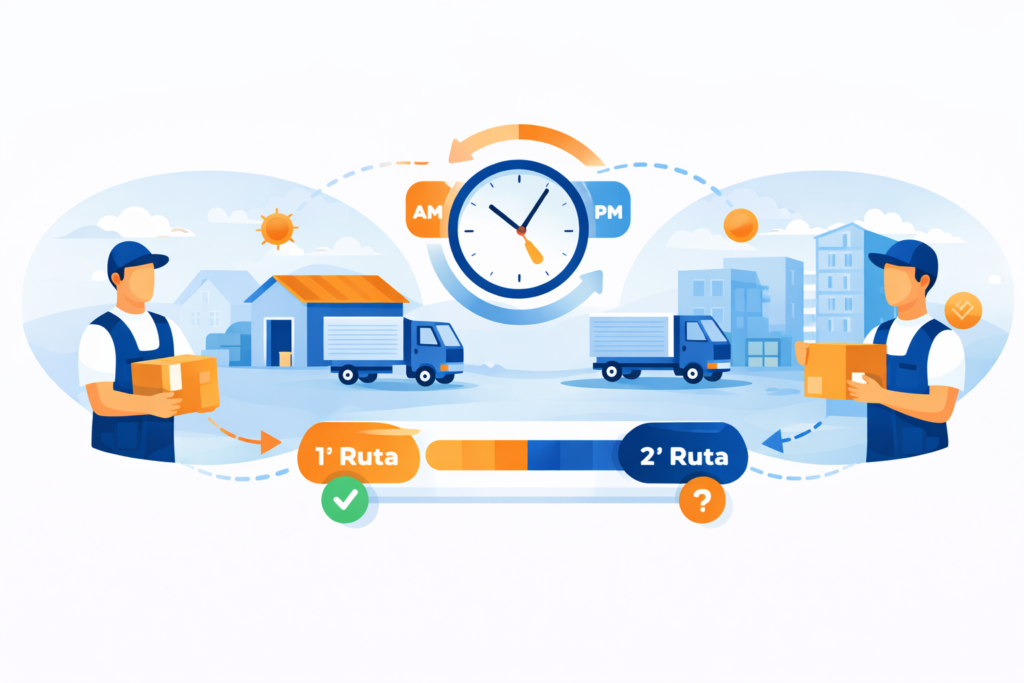
4. Adaptation to Last-Mile and Multi-Shift Operations
In last-mile or urban distribution operations, planning is particularly dynamic.
A single driver may:
- Complete a route in the morning
- Return to the warehouse
- Take on a second route in the afternoon
Without structured management of driver availability in logistics, this type of operation becomes difficult to control.
Integration within a TMS allows companies to:
- Differentiate availability by time slot
- Visualize time already consumed during the working day
- Determine whether there is capacity for a second assignment
- Reduce improvisation and urgent reassignments
This improves operational stability and reduces reliance on manual checks.
5. Greater Operational Stability and Fewer Incidents
When driver availability in logistics is embedded within the planning system:
- Last-minute changes decrease
- Urgent reassignments are reduced
- Driver overload is avoided
- Service predictability improves
In addition, the traffic team works with greater confidence because key information is centralized and up to date.
Planning shifts from focusing exclusively on vehicles and orders to structurally integrating human resources as a strategic component of the operation.
Availability and Traceability: Two Pillars of Efficient Planning
Efficient planning does not depend on a single functionality.
Driver availability in logistics ensures that the initial assignment is viable and aligned with each driver’s real working schedule.
Then, during execution, traceability completes the operational picture. Real-time GPS in logistics makes it possible to know the exact position of vehicles, detect deviations, and maintain control while the route is in progress.
First, planning is done with drivers who are truly available.
Then, execution is monitored with real-time visibility.
Integrating both elements within a TMS enables data-driven planning from start to final delivery.
Beyond the Calendar: A Comprehensive Planning Vision
Driver availability in logistics should not be managed as an external or secondary element.
It must be integrated into the system that makes planning decisions.
When calendars, routes, schedules, and working limits coexist in the same environment:
- Duplications are eliminated
- Human error margins are reduced
- Team coordination improves
- Operational consistency increases
Planning stops depending on manual checks and becomes supported by consolidated information.
Conclusion
Driver availability in logistics is a structural factor in transport efficiency.
Integrating it into a TMS not only prevents assignment errors but also provides stability, control, and foresight across the entire operation.
Route planning is not just about optimizing mileage or reducing kilometers.
It is about managing people, time, and capacity with precision.
And when real availability is embedded from the start, planning moves from reactive to truly strategic.

Communications & Marketing Responsible at Hedyla
Multimedia Technical Engineer. Working 11 years in the Audiovisual and Communication Department of a multinational company. Responsible for the Marketing and Communication Department in several companies in the technology sector.
Designing digital strategies. Innovating and adding value to communication.