
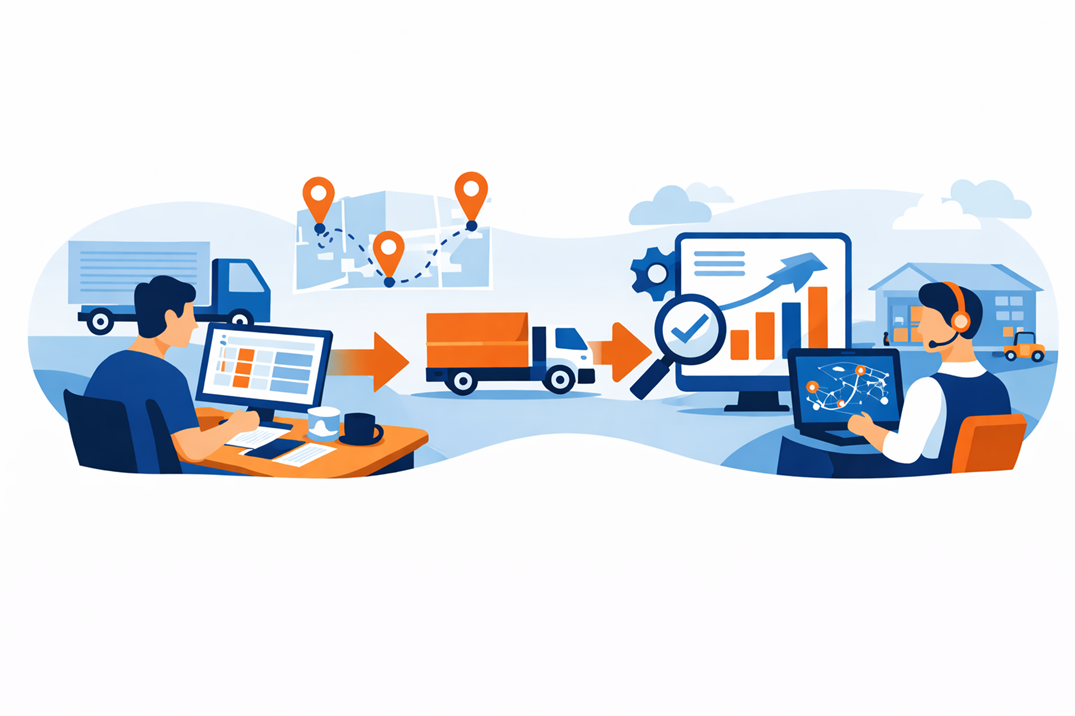
For years, manual transport planning has been the backbone of many transport companies: Excel spreadsheets, phone calls, the planner’s experience, and a great deal of operational knowledge stored in people’s heads.
The issue today is no longer how you started, but how far that model can realistically go in 2026, with increasing operational complexity, tighter margins, and constant daily pressure.
If you are a carrier and recognize yourself in several of these signs, the problem is probably not your people or their commitment, but manual planning itself and the tools you rely on.
1. The operation depends on one or two key people
If one or two people in your company “know everything” and operations suffer when they are not around, you have a critical dependency.
Manual planning concentrates knowledge in the hands of a few, creating operational risk, internal stress, and zero scalability.
In 2026, business continuity cannot depend on anyone’s memory.
2. Every last-minute change breaks your transport planning
An urgent order, a cancellation, a vehicle breakdown, or a driver who cannot start a route. When this happens, do you have to reopen Excel, rebuild routes, and start calling people one by one?
If every disruption means starting almost from scratch, manual planning no longer matches the real pace of the sector and prevents effective route optimization.
3. You do not have a clear view of real vehicle capacity
Pallets, kilograms, linear meters, volume, vehicle restrictions, time windows… If load utilization is calculated “by eye” or with simplified rules, you are likely:
- Underutilizing vehicles
- Absorbing unnecessary costs
- Rejecting freight that could actually fit
Planning without a clear, calculated view of capacity is one of the biggest sources of inefficiency in manual transport planning.
4. Planning and execution are separate processes.
You plan the route in the morning and, from that point on, you can only hope everything goes as expected.
Without structured tracking of what is happening on the road, manual planning loses value as soon as the first truck departs.
In 2026, planning without the ability to adjust in real time is only half the job. Planning and execution must be connected.
5. You cannot simulate scenarios before deciding
What if I group these orders?
What if I switch to a larger vehicle?
What if I move this departure one hour earlier?
With manual planning, these questions are answered through intuition and trial and error.
The inability to simulate routes and costs severely limits decision-making and forces you to “test in production” with real customers and real margins.

6. Excel has become your critical system
Duplicate versions, local files, changes with no traceability, formulas only understood by the person who created them.
When Excel stops being a support tool and becomes the core of the operation, risk increases dramatically.
The problem is not Excel itself, but using it as if it were a TMS or route planning system for tasks it was never designed to handle.
7. Growth only adds more chaos
More customers, more delivery points, more vehicles… and more planning hours.
If growth means expanding the office team, extending working hours, and operating under constant pressure, the foundations of your manual planning model are not sustainable.
Good transport planning should absorb growth and improve productivity, not amplify disorder.
8. You cannot properly analyze what has happened
Where was margin lost on today’s route?
Which routes were least efficient this week?
Which decisions worked and which should be avoided?
If answering these questions requires reconstructing information after the fact, you are managing almost blindly.
Without structured historical data on loads, routes, times, and costs, continuous improvement is impossible.
9. Communication lives in phone calls and WhatsApp
Last-minute changes communicated via phone calls, WhatsApp, or scattered messages. Information that is not recorded, gets lost, or does not reach everyone involved.
When manual transport planning relies on unstructured communication, errors, misunderstandings, and delays are only a matter of time.
10. You feel the problem is not the team, but the system
This is the clearest sign of all. If your team works well, understands the operation, and is still constantly firefighting, the limitation is probably not the people.
The limitation lies in the manual planning model and the tools used to manage the operation.
Looking ahead to 2026: manual transport planning must evolve
Transport planning is no longer just about deciding which truck goes where.
It requires:
- Real visibility into capacity and utilization
- The ability to react while operations are in progress
- Data-driven decision-making, not just intuition
- Reduced dependency on specific individuals
- Scalable operations without losing control or margin
Many carriers do not need more effort from their teams, but a shift in approach toward route optimization software and data-driven planning.
Conclusion: from manual transport planning to the next level
Manual transport planning does not fail overnight. It gradually falls short. First, it creates daily friction. Then, hidden cost overruns. Eventually, it limits business growth.
Identifying these signals early is key to remaining competitive in 2026.
This is not about digitalizing for the sake of it, but about planning daily operations without the system itself becoming the bottleneck.
If you see yourself reflected in several of these situations, you are likely not facing an operational problem, but a clear opportunity to move toward a more advanced planning model, supported by a TMS or route optimization software and reliable data.

Communications & Marketing Responsible at Hedyla
Multimedia Technical Engineer. Working 11 years in the Audiovisual and Communication Department of a multinational company. Responsible for the Marketing and Communication Department in several companies in the technology sector.
Designing digital strategies. Innovating and adding value to communication.