
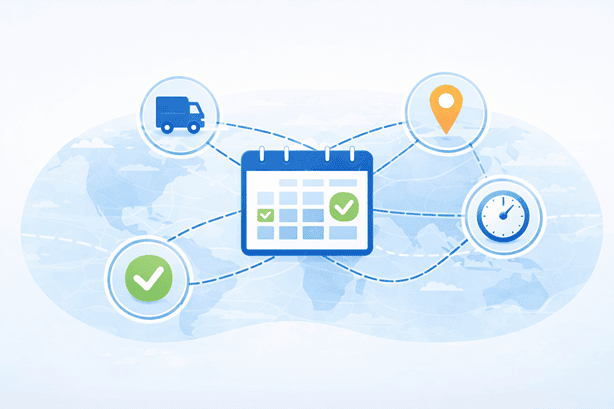
Shift planning in transport doesn’t usually fail because of lack of experience. It fails because there are too many variables that are not in the same place: morning and evening shifts, vacations, sick leave, regional holidays, drivers who already have a route assigned that same day.
And all of this is often managed across Excel files, calendars, calls or simply memory.
The problem doesn’t appear when you plan. It appears later, when the route has already been published.
In this article, we’ll look at how a TMS allows you to integrate all this information directly into the planning process, preventing errors before they impact operations.
The weak point in planning: what you don’t see
In many operations, the traffic team has a fairly clear idea of who is available. But that information isn’t always integrated into the planning process.
This leads to very common situations:
- Drivers assigned during vacation periods
- Overlapping routes on the same day
- Working hours violations
- Last-minute changes that force you to redo the planning
This isn’t a decision problem. It’s a visibility problem at the critical moment.
What changes when shift planning is integrated into a transport TMS
When we talk about shift planning, we’re not just talking about organizing schedules.
We’re talking about making operational decisions with all the relevant information available at the exact moment it matters.
That’s where a TMS software comes in..
Not as just another tool, but as the point where everything comes together:
- Route planning
- Vacation management
- Real driver availability
- Day-to-day operational constraints
The key difference is not having the information… it’s having it while you are planning.
From an informative calendar to context-driven planning
In many companies, shift management works like this:
- Vacations or holidays are recorded
- Availability is checked before planning
- Then routes are built
But this approach has a problem: the information is not part of the decision itself.
With a TMS, the approach changes.
When you define the planning date, the system:
- Analyzes which routes each driver already has assigned
- Calculates how much working time has been consumed that day
- Detects vacations, sick leave or holidays
- Compares everything with actual availability
And most importantly: it shows all of this before confirming the plan.
Real-time alerts while planning
This is where shift planning stops being theoretical and becomes operational.
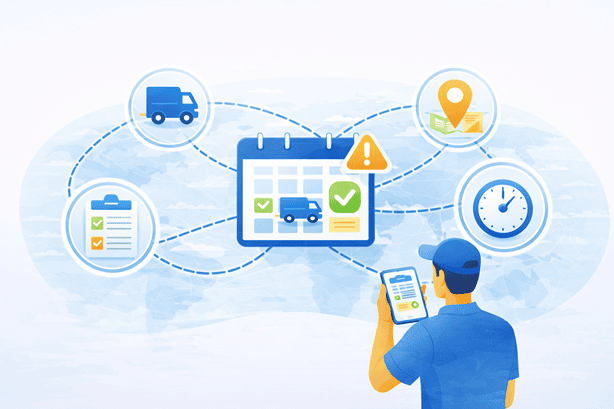
While assigning routes, the system alerts you about situations such as:
- Drivers already assigned to another route that same day
- Part of the working day already consumed
- Resources unavailable due to vacation or sick leave
- Potential working hours violations
It’s not about blocking decisions. It’s about making decisions with context.
This allows you to:
Know if a driver can take on a second route
👉 Differentiate between morning and afternoon shifts
👉 Adjust before the issue reaches execution
Shift planning: adapting to different types of operations
Not all companies operate in the same way.
Some work with clearly defined shifts:
- 6:00 – 14:00
- 14:00 – 22:00
Others have more flexible models:
- Broad availability ranges
- Daily working hour limits
- Adjustments based on workload
The key is that the system can adapt to both scenarios:
- Defining specific time slots
- Or working with total availability and maximum daily hours
And in both cases, automatically evaluating whether a route fits within that context.
Managing vacations and workforce exceptions without friction
Vacation management is often one of the biggest sources of errors.
Not because the information isn’t recorded, but because it’s not integrated into the planning flow.
When that changes, operations change as well:
- Vacations are detected automatically
- Sick leave appears directly in planning
- Holidays are applied based on calendars
- Workforce exceptions become part of the decision
The shift is simple, but powerful:
👉 From checking before planning
👉 To receiving alerts while planning
When planning is not aligned with execution
This is where many operations start to struggle.
When planning doesn’t take real availability into account, problems appear in sequence:
- Last-minute reassignment
- Route delays
- Driver overload
- Unexpected incidents
In fact, many of these situations are clear signs that operations have outgrown the tools used to manage them.
In this article, we explore these signals in detail 👉 https://hedyla.com/en/transport-costs/
Real impact on day-to-day traffic operations
When shift planning and exception management are integrated into a TMS, the impact is quickly noticeable:
- Fewer errors before publishing routes
- Fewer last-minute changes
- Less reliance on Excel or memory
- More stability in daily operations
And above all, something very tangible for traffic teams:
👉 Less improvisation
👉 More real control over what’s happening
Conclusion
Planning routes is not just about fitting orders together. It’s about doing it with people who have schedules, limits and real availability.
When that information is outside the system, errors are inevitable.
When it becomes part of the planning process, they simply stop happening.
The difference is not planning faster. It’s planning with context.

Communications & Marketing Responsible at Hedyla
Multimedia Technical Engineer. Working 11 years in the Audiovisual and Communication Department of a multinational company. Responsible for the Marketing and Communication Department in several companies in the technology sector.
Designing digital strategies. Innovating and adding value to communication.