
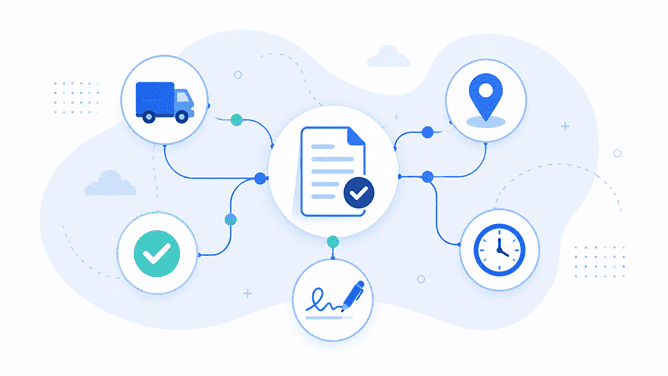
For years, transport documentation has operated more out of habit than by design.
Paper delivery notes moving from one place to another.
Consignment notes filled out multiple times.
Signatures arriving late… or not arriving at all.
Meanwhile, transport planners are left waiting to close the process.
The issue is not the paper itself. It’s everything that depends on it.
When a document does not arrive, is incomplete or unreliable, the impact goes far beyond administration. It affects planning, invoicing and, in many cases, the customer experience itself.
And that model is starting to fall short of what transport operations require today.
Digital transport documentation is not about format, but about process
When companies talk about digital transport documentation, many think about doing exactly the same thing… just in PDF format.
But the real change is not about that.
It has much more to do with when things happen and who has access to the information at each stage.
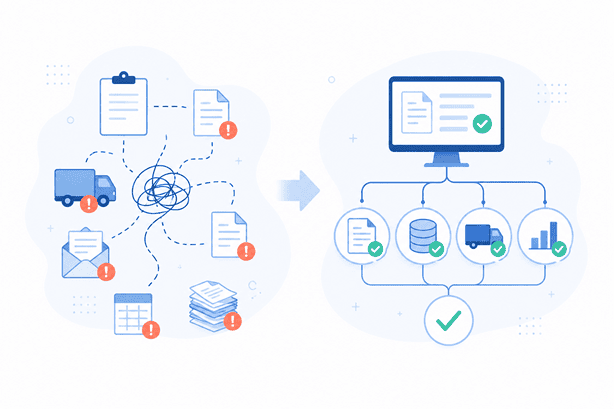
In a traditional model:
- Documents are created before or after the transport process
- Information is completed manually
- Validation arrives too late
- Errors are detected when there is no time left to react
- Information is spread across planners, drivers and administration teams
In a model where digital transport documentation is integrated:
- Documents are generated automatically from the order
- Information is already structured from the beginning
- Validation happens before execution
- Control becomes immediate
- Everyone works from the same source of information
What changes is not the document format itself, but the way the operation is organised.
Why digital transport documentation can no longer be postponed
There comes a point when maintaining the same model is no longer sustainable, and regulation is one of the factors accelerating this shift.
The mandatory implementation of digital transport control documents is forcing many companies to rethink how they manage documentation.
But beyond regulation, there is the reality of day-to-day operations.
More routes.
More deliveries.
More customers demanding real-time information.
And teams that need to make decisions using information that is often unavailable at that exact moment.
When information arrives late or incomplete, operational adjustments begin to appear: delayed validations, unclear incidents and decisions made without the full context.
That is when operations start to lose stability.
What really changes when working with digital transport documentation
Once documentation becomes part of the operational flow, one thing becomes noticeable very quickly: a large part of the “reactive” work disappears.
Transport planners stop chasing information
When digital transport documentation is integrated, planners no longer spend their time chasing missing information.
Instead, they work with data that has already been validated from the start.
On a daily basis, this means:
- fewer internal calls
- fewer manual checks
- fewer decisions made with incomplete information
And above all, less dependence on “let’s see if it arrives”.
Drivers become part of the system
In many operations, drivers are the most disconnected part of the documentation process.
They complete deliveries… and afterwards someone else has to reconstruct what happened.
With digital transport documentation:
- signatures are collected immediately
- incidents are recorded at the exact moment they happen
- information enters the system directly
This avoids having to rebuild the process later and allows teams to work with reliable information from the very beginning.
Administration stops correcting and starts validating
One of the biggest hidden costs is found here.
Not in creating documents, but in correcting them.
- mismatched data
- incomplete documents
- duplicated information
When documentation is generated from validated data at the source, all of that corrective work gradually disappears.
And the impact becomes visible very quickly in both time savings and error reduction.
The most common mistake when implementing digital transport documentation
One of the most common mistakes is trying to digitalise operations without reviewing how the business is actually working.
In other words, moving the same process into a tool… while expecting different results.
That is usually when frustration appears.
Errors continue to happen.
Data remains inconsistent.
And the tool ends up being used to manage problems that already existed beforehand.
Because if information enters incorrectly, arrives incomplete or every person works differently, digitalisation will not automatically organise the operation.
It simply makes those weaknesses more visible.
That is why, before moving forward, it makes sense to review the starting point: how orders are managed, how information flows across departments and which processes still depend on manual tasks or individual decisions.
In fact, many of these warning signs begin to appear when manual transport planning is no longer sustainable on a daily basis 👉 https://hedyla.com/en/manual-planning-in-transport-is-no-longer-sustainable/
What needs to be ready before digitalising
Operations do not need to be perfect.
But they do need a minimum foundation to build on.
Reliable data
- clearly defined addresses
- structured customer data
- clear order types
Understandable processes
- who generates the information
- when it is validated
- how exceptions are managed
Controlled order flow
- how information enters the system
- when it becomes ready for planning
- which fields are mandatory
Without this foundation, digital transport documentation does not simplify operations.
It usually adds complexity.
The role of TMS software in digital transport documentation
This is where everything starts to fit together.
A TMS software solution does much more than organise routes.
It allows digital transport documentation to become part of the operational flow from the very beginning, connecting orders, planning and execution.
When working with TMS software:
- documents are generated automatically from the order
- data is validated before assignment
- documentation is linked to each route
- drivers interact directly with that information
- everything is recorded in real time
From that point onwards, the change becomes clear: information stops being scattered and becomes structured and accessible to the entire team.
From documentation to full traceability
When digital transport documentation is integrated, it stops being an isolated element.
It becomes part of the traceability of the entire operation.
That means:
- every action is recorded
- every document has context
- every incident has a clear origin
And that completely changes the way daily operations are managed.
Because teams no longer need to search for information. They can work directly with it.
What really changes: less operational friction
This is the point that becomes most noticeable in everyday operations.
When documentation stops being a problem:
- transport planners work more smoothly
- administration reduces workload
- errors decrease
- internal communication improves
And all of this happens without adding more work, simply by reorganising how information flows through the operation.
Conclusion: documentation is no longer the end of the process
Digital transport documentation is not just an administrative improvement. It is an operational improvement.
The companies moving forward are not necessarily the ones with the most tools. They are the ones that have integrated documentation into the operational flow itself.
Because once documentation becomes part of the process, operations stop depending on reviewing what already happened and start being built on reliable information from the very beginning.

Communications & Marketing Responsible at Hedyla
Multimedia Technical Engineer. Working 11 years in the Audiovisual and Communication Department of a multinational company. Responsible for the Marketing and Communication Department in several companies in the technology sector.
Designing digital strategies. Innovating and adding value to communication.