
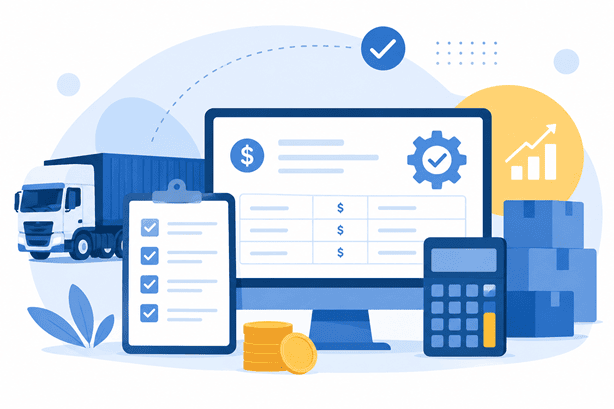
Automate transport rates to simplify one of the most time-consuming aspects of the financial management of transport operations. In addition to knowing which services have been completed, teams need to check which rate should be applied, validate the amounts and prepare the information correctly before invoicing customers or suppliers.
When these tasks depend on manual checks, the time required increases as the volume of operations grows. So does the risk of applying an incorrect rate, leaving services pending invoicing or detecting discrepancies when the process is already too far advanced.
Automating rates and pre-invoicing allows many of these checks to be handled by the TMS while maintaining a validation point before invoices are generated. This allows the team to focus its attention on operations that genuinely require review.
The challenge goes beyond calculating a rate
A transport operation may be subject to different financial conditions depending on the customer, supplier or the service itself.
Managing rates therefore involves more than maintaining a price table. These conditions need to be linked to the corresponding operations and the correct amount applied in each case.
When this information is spread across spreadsheets, documents or manual checks, each service requires additional intervention before it can be invoiced.
And as the number of orders and routes increases, maintaining this model becomes increasingly difficult.
How to automate transport rates and reduce manual checks
One of the advantages of centralising rates in a TMS is that the system can use them directly to assign a price to operations.
Rates can be configured for both customers and suppliers and applied at order or route level, depending on how the operation is organised.
This means that when it is time to prepare invoicing, a significant part of the work has already been completed.
The team does not have to start from scratch, reviewing every service and looking for the corresponding conditions. Instead, it can work from the information already available in the system and focus on checking that the result is correct.
The ability to automate transport rates therefore helps reduce repetitive tasks and, above all, reliance on manual processes where errors are more likely to occur.
Transport pre-invoicing: automation while maintaining control
Automating the process does not mean that invoices have to be issued without supervision.
Transport pre-invoicing introduces an intermediate validation step. Before an operation moves on to invoicing, the team can check the assigned price and confirm that the information is correct.
If there is a rate that meets the established conditions, it can be used to assign the price. An amount can also be entered manually when the situation requires it.
Automation handles repetitive tasks while the team retains decision-making capacity for exceptions.
Managing orders and routes individually... or in batches
As the volume of operations increases, reviewing and processing every service individually can become a bottleneck.
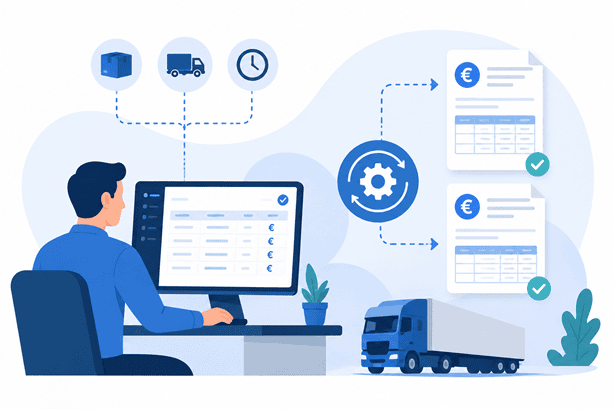
For this reason, pre-invoicing can be carried out for a specific order or route, or for several operations simultaneously.
This makes it possible to adapt the process to day-to-day requirements.
An exceptional operation can be reviewed individually, while those that meet the established conditions can be processed together.
The aim is simple: avoid spending the same amount of time on a standard operation as on one that genuinely requires attention.
From completed service to invoice, with fewer manual steps
Once pre-invoicing has been validated, operations move on to the invoicing process.
The system can create new invoices or add lines to existing invoices according to the configured conditions and invoicing periods.
While an invoice remains pending, new pre-invoiced lines can be added. Once it has been sent, it can no longer be modified.
This workflow clearly separates three stages: calculating the amount, validating it and finally issuing the invoice.
This separation also helps identify potential errors before they reach the final stage.
Greater financial control does not mean more checks
There is a tendency to associate control with manually reviewing every operation.
However, greater control does not necessarily require more manual intervention.
A properly automated process allows the team to focus on exceptions and provides more structured information for decision-making.
Technology applies the defined rules and prepares the information. People validate cases that require judgement or additional review.
This model streamlines the process while maintaining control over what is invoiced to customers and what needs to be paid to suppliers.
Correctly managing rates is also only one part of financial management. In our article “Common mistakes when calculating transport costs (and how to avoid them with technology)” we look at some of the errors that can affect cost calculations and, consequently, the profitability of each operation.
From planning to financial control in the same TMS
Transport efficiency does not end with good planning.
What happens afterwards also matters: how completed services are transferred to financial management and how much work the team needs to complete the process.
A TMS can connect transport operations with processes such as rate management and pre-invoicing, reducing manual tasks and making it easier to validate information before invoicing.
Automating rates and pre-invoicing helps reduce errors, apply consistent criteria and gain greater control over a fundamental part of transport operations: their financial performance.

Communications & Marketing Responsible at Hedyla
Multimedia Technical Engineer. Working 11 years in the Audiovisual and Communication Department of a multinational company. Responsible for the Marketing and Communication Department in several companies in the technology sector.
Designing digital strategies. Innovating and adding value to communication.