
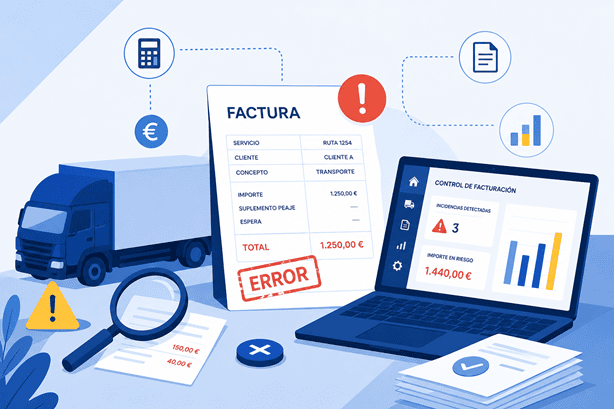
It’s six o’clock on a Friday afternoon, and someone in the finance department is reviewing the month-end accounts when they spot a transport service billed using another customer’s rate. It’s not an isolated case. Two more invoices reveal an unpaid toll charge and a 40-minute waiting time that never made it into the final amount.
None of these issues were detected when they happened. They were discovered later, as is so often the case with transport invoice errors: when a customer calls to question a charge, when the margin on a route doesn’t add up, or when someone finally has the time to review each service one by one at the end of the month.
Most content about transport pricing focuses on preventing these problems from happening in the first place: how to structure rate tables, define surcharges, or build a solid pre-invoicing process. All of that is essential, but it leaves one important question unanswered: what happens if the mistake has already been made? This article focuses on exactly that: the real cost of invoice errors once they have been issued, and what to do in the hours after discovering them.
Why Pricing Errors End Up on the Invoice
In transport operations, pricing is rarely a simple fixed number that can be copied and pasted. It varies depending on the customer, the type of service, the distance travelled, the vehicle used, or whether additional charges such as ADR, temperature-controlled transport or waiting time need to be applied.
That works well while one person keeps everything under control and has enough time to review each service carefully. The problem appears as the operation grows. The person who once checked twenty services a day now has to review two hundred in exactly the same number of hours. At some point, something gets missed. Not because anyone is doing a poor job, but because manually checking hundreds of exception, each one differen, is simply not a process that scales.
The Real Cost of Transport Invoice Errors
This is where it's worth stopping to do the maths, because the feeling that "it's only a few mistakes" often hides a much larger financial impact than expected.
Several logistics industry studies estimate that between 3% and 5% of transport invoices contain some type of pricing error, whether overcharging or undercharging. That may sound like an acceptable margin of error. But let's look at a simple example. A company issuing 2,000 transport services per month, with a 4% error rate and an average deviation of €18 per incorrect invoice, is losing around €1,440 every month without that amount ever appearing as a specific line in any report. Over a year, that's more than €17,000, spread across many small discrepancies that rarely attract attention.
If you'd like to calculate the impact using your own figures, the formula is straightforward:
Monthly services × % of invoices with errors × Average deviation per error = Hidden monthly cost
That result alone may not justify replacing your transport management system. But it will tell you something you probably don't know today: exactly how much money you're losing by continuing to review transport rates manually.
What to Do Once the Error Is Already on the Invoice
Even with well-defined pricing rules, sooner or later an error will slip through. What really makes the difference is how the company reacts in the hours after detecting it.
Detect the Error Before the Customer Does
There is a big difference between identifying an issue internally and receiving a phone call from a customer asking why they have been overcharged. In the first case, it's an operational issue. In the second, it also becomes a matter of trust. That's why it's worth spending a few minutes before sending each batch of invoices reviewing charges that fall outside the normal range for that customer or service type. There's no need to check everything. Focusing on the values that break the usual pattern is often enough.
Correct the Error Without Damaging the Relationship
If the invoice has already reached the customer or carrier, being the first to acknowledge the mistake makes a significant difference. A call saying, "We've identified an error in your latest invoice and we're already correcting it," is almost always received better than waiting for the customer to discover the issue first. Issuing the corrective invoice quickly and explaining briefly what happened helps prevent an isolated incident from becoming a sign of poor financial control.
Prevent the Same Mistake from Happening Again
This is the step that is often overlooked in the rush of day-to-day operations. Take a moment to record what type of error occurred. Was a specific surcharge forgotten? Did it involve the same customer as before? Was it caused by a manual calculation instead of an automated pricing rule? Without this simple record, every mistake is corrected as if it were the first one, allowing the same issue to reappear weeks later with another customer or another carrier because nobody identified the underlying pattern.
How a TMS Solves the Problem
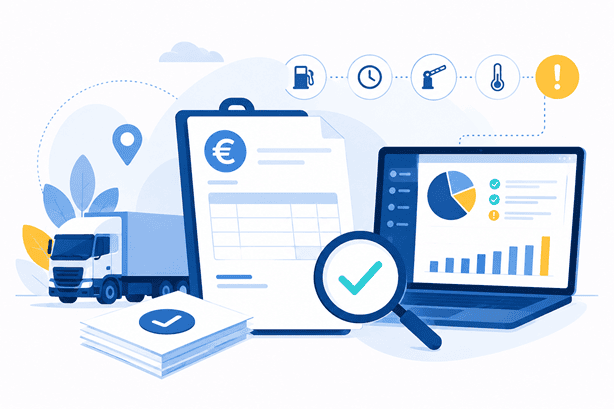
The most effective way to eliminate this hidden cost isn't to review invoices more carefully—it's to stop relying on manual calculations in the first place. A TMS Software stores customer and carrier rate tables directly within the platform, allowing every transport service to be priced automatically using the correct rates, surcharges and business rules.
Before anything becomes an invoice, the system provides a pre-invoicing screen where the calculated amounts can be reviewed. Once approved, the information flows directly into the invoice without anyone having to re-enter data or worry about manual mistakes.
- Fewer hours spent checking every transport service before invoicing.
- Fewer customer calls questioning unexpected charges.
- Better visibility into the real profitability of every route, customer and carrier.
- Carrier payments that accurately match the agreed pricing, without unpleasant surprises.
Conclusion
Transport management doesn't end when the truck reaches its destination. The process continues through invoicing, and that's where many seemingly minor mistakes end up having a real financial impac, even if nobody has ever added them up in a spreadsheet.
This article has focused on what happens after an invoicing error has already occurred: understanding its cost and knowing how to respond effectively. If your goal is to prevent these mistakes from happening in the first place by building a robust pricing structure and an efficient pre-invoicing process, the next step is to read our Definitive Guide to Transport Pricing and Pre-Invoicing, which explores the topic in much greater depth.

Communications & Marketing Responsible at Hedyla
Multimedia Technical Engineer. Working 11 years in the Audiovisual and Communication Department of a multinational company. Responsible for the Marketing and Communication Department in several companies in the technology sector.
Designing digital strategies. Innovating and adding value to communication.