
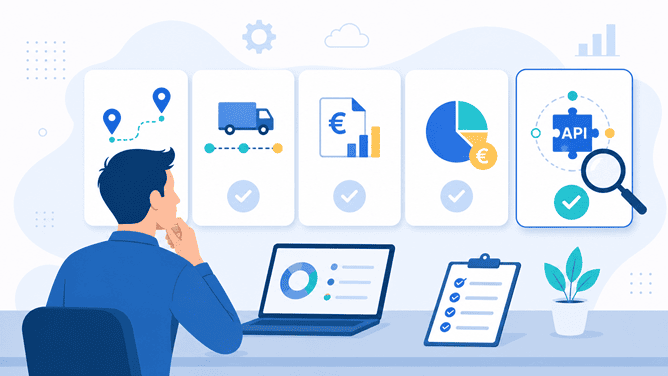
An order arrives by email.
Someone enters it into the ERP.
Then it is entered again into the TMS to plan the route.
Later, the information is sent to the warehouse to prepare the shipment.
Once the delivery is completed, the proof of delivery returns to the administrative department to close the process and generate the invoice.
Each step seems simple on its own. The problem arises when this sequence is repeated hundreds or thousands of times every week.
Many transport and logistics companies already have specialized tools to manage different parts of their operations. However, a large part of the daily workload still consists of moving information from one system to another.
Copying data.
Exporting files.
Importing spreadsheets.
Sending emails.
Validating information manually.
Meanwhile, teams spend time on administrative tasks that add little value to the operation.
That is why, when a company considers implementing a transportation TMS, one of the most important questions should not focus solely on the software’s features. It should also consider how the system will exchange information with the other tools used on a daily basis.
This is where APIs become critically important.
What Is an API in Logistics?
API stands for Application Programming Interface. o Interfaz de Programación de Aplicaciones.
Although it may sound like a technical concept, its purpose is quite simple: to allow two systems to share information automatically.
An API acts as a communication channel between different applications.
Through an API, one system can request data, send information, or update records in another platform without requiring manual intervention.
A common example in logistics is order creation.
When an order is generated in an ERP and automatically appears in the TMS ready for planning, an API is usually responsible for that information exchange.
The same happens when a GPS platform sends real-time vehicle locations, when a customer checks the status of a delivery, or when a digital document is automatically stored in the corresponding system.
An API does not replace applications. Instead, it enables them to work together.
And the more connected the systems are, the less effort is required to keep information updated.
The Real Problem Is Not the Software—It’s That the Systems Cannot Communicate
Over the years, many organizations have adopted new tools to solve specific needs.
An ERP for business management.
Transportation management software.
A GPS platform for the fleet.
Mobile applications for drivers.
Document management tools.
Customer portals.
Individually, each system may work perfectly.
The problem appears when information does not flow between them.
That is when processes start to emerge that eventually become part of the daily routine:
- Exporting orders to import them into another platform.
- Updating statuses manually.
- Searching for documents through email threads.
- Entering the same information multiple times.
- Comparing data across different systems.
Beyond the time they consume, these tasks generate errors, delays, and a lack of visibility that ultimately affects the entire operation.
In fact, many of these situations are signs that the operation has grown faster than the tools used to manage it. Before starting a technology project, it is worth reviewing how processes are currently managed, what information flows between departments, and how prepared the organization is to work in a more integrated way. In our guide on TMS implementation , you can explore the key factors that help prepare a project and facilitate user adoption.
The challenge is no longer adding more technology.
The challenge is making the existing technology work together.
How an API Connects a TMS with the Rest of the Operation
A TMS sits at the center of many logistics processes.
It receives orders.
Plans routes.
Manages resources.
Controls incidents.
Centralizes documentation.
Shares information with customers and carriers.
That is why its integration capabilities have a direct impact on operational efficiency.
Let’s imagine a typical scenario.
A customer places an order.
The ERP automatically records the information and sends it to the TMS through an API.
The TMS uses that data to plan distribution and assign vehicles or drivers.
During execution, tracking information is updated through connections with GPS systems or mobile applications.
When the delivery is completed, the proof of delivery is automatically registered and the information is sent back to the ERP to continue administrative and invoicing processes.
All of this happens without exporting files or manually entering data.
Each system maintains its specific role, but they all work with the same information.
Which Processes Can You Automate When Your TMS Is Integrated?
API-based integration has practical applications throughout nearly every stage of logistics operations.
One of the most common use cases is the automatic reception of orders.
Instead of importing files or manually entering information, orders arrive directly in the TMS from the ERP or customer systems.
Integration with GPS platforms and fleet management systems is also very common.
As a result, route statuses can be updated automatically and shared in real time with customers, traffic managers, or internal departments.
Another area where APIs provide significant value is digital documentation.
Waybills, control documents, eCMRs, digital delivery notes, and proofs of delivery can be generated, stored, and shared without manual processes.
These integrations help reduce administrative errors, improve traceability, and speed up access to information from any point in the operation. They are becoming even more relevant with the introduction of mandatory digital transport control documents. In our practical guide to the mandatory digital control document in 2026 , we analyze the main changes and how companies can prepare for them.
Invoicing is another common example.
Once a service is completed, the required data can be automatically sent to the appropriate system, streamlining administrative workflows.
Communications also benefit from these integrations.
Delivery notifications, delay alerts, status changes, or incidents can be automatically sent to customers and partners without requiring additional actions.
As operational volumes increase, this level of automation enables companies to handle more work without proportionally increasing their administrative workload.
What Should You Ask About APIs Before Choosing a TMS?
When a company evaluates different transportation management solutions, it usually focuses on visible features.
Route optimization.
Traceability
Rate management.
Cost control.
Resource planning.
However, integration capabilities often receive less attention than they deserve.
Before making a decision, it is worth answering some important questions.
Does the provider offer public and documented APIs?
Can it exchange both inbound and outbound information?
Which types of systems does it commonly integrate with?
Can it adapt to the company’s specific processes?
Who is responsible for maintaining integrations?
The answers to these questions help determine whether the solution will be able to evolve alongside the organization’s needs.
Because an integration that works today should also support the future growth of the business.
Moving Information Is Just as Important as Moving Goods
For many years, logistics efficiency has been associated primarily with route optimization, mileage reduction, or maximizing vehicle capacity.
All of these aspects remain essential.
However, a significant part of productivity also depends on how information flows within the organization.
When systems are disconnected, teams spend time searching for data, correcting errors, or transferring information between platforms.
When systems are connected, information moves automatically alongside the process.
APIs make that connection possible.
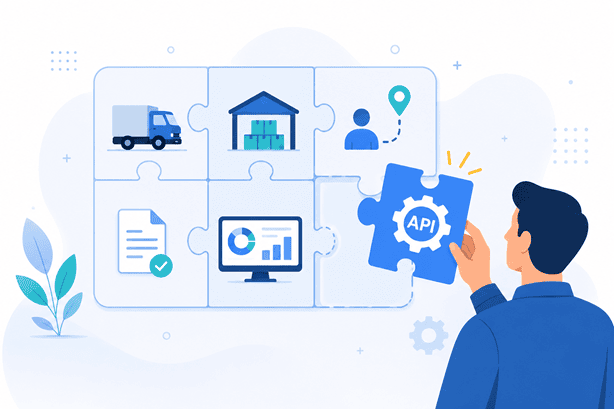
They enable ERPs, TMS platforms, warehouses, fleet management systems, document management platforms, and communication tools to share information continuously and reliably.
That is why, when evaluating a TMS, understanding its integration capabilities is just as important as reviewing its features.
Because the less time an organization spends moving information between systems, the more time it can dedicate to what truly creates value: managing transportation, improving service quality, and making decisions based on up-to-date information.

Communications & Marketing Responsible at Hedyla
Multimedia Technical Engineer. Working 11 years in the Audiovisual and Communication Department of a multinational company. Responsible for the Marketing and Communication Department in several companies in the technology sector.
Designing digital strategies. Innovating and adding value to communication.