
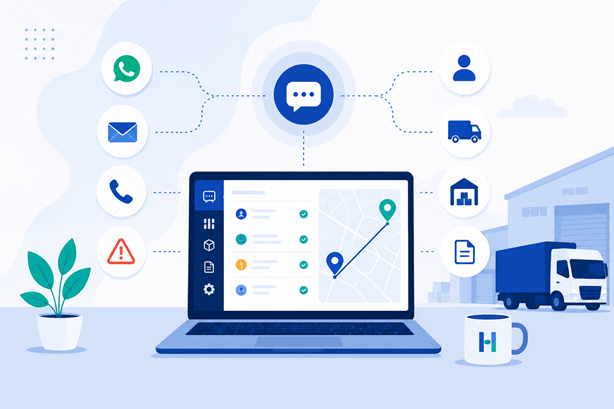
An incident arrives via WhatsApp.
A customer sends an email.
A carrier calls to report a delay.
Meanwhile, the traffic department is trying to piece together what actually happened.
This situation is more common than it may seem.
As operations grow, so does the number of people involved in each shipment: customers, planners, drivers, subcontracted carriers, administrative staff, and customer service teams.
Each stakeholder uses different communication channels.
The result is often a large amount of information spread across phone calls, emails, messaging apps, and independent tools.
The challenge is not just the volume of messages.
The real difficulty lies in maintaining the context of each operation when information is scattered across multiple channels.
That is why more and more companies are reviewing how they manage transportation communication and looking for ways to centralize it within their operational processes.
Why Communication Becomes More Complex as Operations Grow
In a small operation, many issues can be resolved through phone calls or direct messages.
However, as volumes increase, this approach starts to reveal its limitations.
A single shipment may generate communications related to:
- Schedule changes
- Delivery delays
- Loading confirmations
- Transportation incidents
- Documentation requests
- Claims or post-delivery inquiries
Each interaction generates valuable information for the operation.
If that information is not recorded in a structured way, finding it later can become a slow and inefficient task.
In addition, people change shifts, take leave, or multiple teams become involved in the same operation.
When information depends solely on private conversations, traceability suffers.
The Hidden Costs of Dispersed Information
Many companies assume that using multiple communication channels is simply part of daily operations.
However, this situation creates costs that are not always visible.
Time Spent Searching for Information
A significant portion of operational time is not spent resolving incidents but locating previous conversations.
Searching emails.
Reviewing call histories.
Checking messages.
Asking colleagues.
Small tasks that, when repeated across hundreds of operations, consume a considerable amount of time.
Greater Risk of Errors
When information is shared through multiple channels, misunderstandings become more likely.
A change communicated by phone may not reach everyone involved.
An incident reported via WhatsApp may never be formally recorded.
An update sent by email may go unnoticed.
The more communication points exist, the harder it becomes to maintain a single source of truth.
Reduced Ability to Track and Analyze
A lack of centralization also makes it difficult to review what happened afterward.
Questions such as the following become harder to answer:
- When was the incident reported?
- Who handled it?
- What solution was applied?
- How long did it take to resolve?
Without traceability, continuous improvement becomes much more difficult.
Signs That Communication Has Become an Operational Problem
In many organizations, the issue does not appear overnight.
It develops gradually.
Common warning signs include:
- Teams use multiple channels for the same operation.
- Questions are repeated because information is not easily accessible.
- Different versions of the same incident exist.
- Communication history is difficult to locate.
- Traffic managers spend too much time searching for information.
- Customers receive different answers depending on who responds.
When these situations become frequent, communication stops being a simple exchange of messages and becomes a source of inefficiency.
What a Centralized Transportation Communication System Should Provide
Centralizing communication does not mean eliminating existing channels.
It means ensuring that all operationally relevant information is recorded and accessible from a single environment.
To achieve this, a system should allow organizations to:
Maintain Operational Context
Conversations should be linked to the operation that generated them.
This makes it much easier to understand incidents and follow up on them later.
Share Information with All Stakeholders
Customers, traffic teams, carriers, and other participants need access to the information relevant to them without relying on lengthy email chains or forwarded messages.
Provide an Accessible Communication History
Every conversation, notification, and update should remain available for future reference.
This supports operational continuity and reduces dependence on individual memory.
Reduce Unnecessary Interruptions
When information is organized and accessible, there is less need for constant phone calls to check the status of an operation.
How a TMS Helps Centralize Communication
The digitalization of transportation has enabled many companies to integrate communication directly into their management tools. A TMS can become the central hub where all operational information is concentrated.
In addition, for this centralization to work effectively, information must flow between the different systems involved in the operation. That is why integrations are playing an increasingly important role in transportation digitalization. Understanding what an API is in logistics and why it is essential for connecting a TMS helps explain how different systems can automatically exchange information.
As a result, conversations are no longer separated from orders, routes, or incidents.
Information remains connected to its operational context and can be accessed whenever needed.
This integration also enables:
- More structured incident tracking
- Better coordination between departments
- Improved traceability of decisions
- Quick access to communication history
- Reduced dependence on external tools
Communication ceases to be a separate process and becomes an integral part of transportation management.

Benefits for Traffic Teams, Customers, and Carriers
When communication is centralized, the benefits extend to everyone involved in the logistics chain.
Traffic departments gain a more complete view of each operation.
Customers receive faster and more consistent responses.
Carriers can report incidents or access information within the same operational environment.
And the organization as a whole gains greater visibility into what is happening at any given moment.
The goal is not simply to send messages.
It is to ensure that the right information is available at the right time and linked to the process that matters.
Conclusion
The complexity of transportation operations does not depend solely on routes, vehicles, or orders.
It also depends on how information flows between the people involved in each service.
When communication is scattered across multiple tools, interruptions increase, errors become more common, and follow-up becomes more difficult.
Centralizing communication improves coordination, reduces management time, and provides a clearer view of ongoing operations.
And as activity volumes grow, the value of having a single place where all transportation-related information can be found becomes even greater.

Communications & Marketing Responsible at Hedyla
Multimedia Technical Engineer. Working 11 years in the Audiovisual and Communication Department of a multinational company. Responsible for the Marketing and Communication Department in several companies in the technology sector.
Designing digital strategies. Innovating and adding value to communication.