
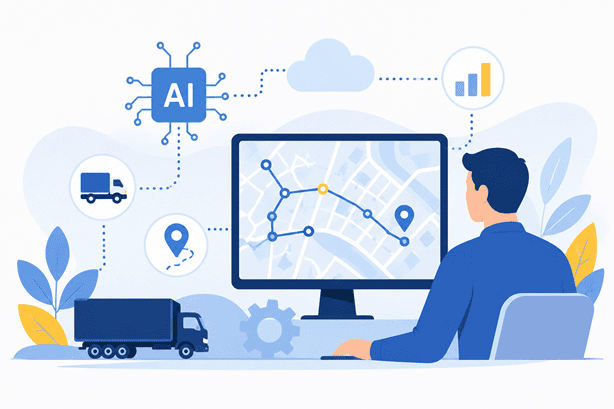
Artificial intelligence in logistics makes headlines, dominates keynotes, and is present in virtually every conversation related to transport. It doesn't matter which event we attend or which meeting we participate in: sooner or later someone asks the same question. What is going to happen to planners? Will they still be necessary when technology is capable of calculating routes in a matter of seconds?
It is an understandable question. Over recent years we have seen how transport planning has evolved at high speed. What previously required hours of manual work can today be resolved in much less time thanks to tools capable of processing thousands of combinations and proposing the best alternative according to the constraints of each operation.
However, we might be approaching the debate from the wrong perspective.
Because the job of a traffic manager has never consisted solely of planning routes. If that were the case, artificial intelligence would probably have solved the problem long ago. Reality is considerably more complex, and that is precisely why human judgment remains essential.
What Does a Transport Planner Really Do?
When we talk about planning, we usually think of vehicles, routes, and kilometers. These are three essential elements, but they represent only a fraction of the work behind a transport operation.
Every day begins with a plan that, on paper, seems perfectly organized. However, it only takes a customer moving up a delivery, a vehicle breakdown, or an urgent order popping up for that plan to no longer be valid. That is the exact moment when the traffic manager's real work begins.
Their role consists of continuously making decisions. Some are simple, while others force them to weigh multiple factors at the same time. Is it worth reorganizing several routes to handle an emergency? Is it better to take on a few extra kilometers to honor a commitment to a client? What impact will that change have on the rest of the deliveries scheduled for the day?
These decisions do not appear on a spreadsheet. Nor are they resolved solely by applying an algorithm. They require an understanding of operations, business priorities, and how certain changes affect distribution as a whole.
That is why it is overly simplistic to reduce planning down to route building. Planning is, above all, a sequence of decisions.
How Is Artificial Intelligence in Logistics Changing Transport Planning?
This is where artificial intelligence brings about a major shift.
For years, traffic departments have devoted a significant portion of their workday to tasks that, while necessary, added little value from a knowledge standpoint: recalculating routes, reorganizing orders, checking capacities, reviewing restrictions, or searching for the most efficient combination of vehicles and shipments.
Today, those tasks can be automated much faster thanks to algorithms capable of analyzing hundreds or thousands of possibilities simultaneously. Artificial intelligence in logistics makes it possible to generate planning proposals while taking into account factors such as time windows, vehicle capacities, traffic restrictions, or service priorities.
But there is an important nuance.
Just because a tool is capable of proposing a plan does not mean it can decide on its own which option is best for a specific company. Technology works with data. People are still the ones who interpret the context in which that data makes sense.
And that context is becoming increasingly complex.
Just a few years ago, finding the most efficient route was enough. Today, planning must also adapt to access restrictions, low-emission zones, specific delivery windows, or particular requirements from certain clients. That reality forces many more variables into the planning process and proves just how much a traffic manager's job goes far beyond finding the shortest route.

Communications & Marketing Responsible at Hedyla
Multimedia Technical Engineer. Working 11 years in the Audiovisual and Communication Department of a multinational company. Responsible for the Marketing and Communication Department in several companies in the technology sector.
Designing digital strategies. Innovating and adding value to communication.